

Imagine running a business entirely dependent on the internet where your team cannot access files in real-time, your software is outdated, and video calls keep dropping. Customer queries are delayed, and data backups are a nightmare. Now, picture this happening frequently. This is the harsh reality of relying on legacy infrastructure like DSL and on-premises servers in a world that has already moved past these technologies. For companies trying to compete in the digital economy, that kind of setup will hold your business back.
As of 2025, nearly 28% of all business activity is conducted online. The effects of slow internet and legacy hardware are explained here. The facts underline that digital transformation is a requirement for businesses that rely on the internet for seamless operations.
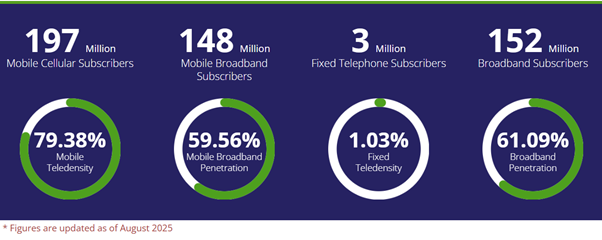
While certain data is limited regarding Pakistan’s internet numbers, the country is most certainly at a turning point. The country boasts over 152 million broadband subscribers in 2025, nearly 46% of the population. Mobile broadband adoption is even higher, with 148 million broadband subscribers. This surge is fuelling internet penetration and cloud service growth, driven by digital transformation initiatives.
The cloud computing market in Pakistan is growing due to policy backing and increasing adoption. It is hard to ignore the impact of cloud services as the cloud-based applications are quite popular in Pakistan, and businesses of all sizes are dependent on them. Just observe how reliant your daily business workflows are on cloud-based applications like Office 365, Teams, Gmail, Slack, and Salesforce, to name a few.
Businesses seek scalability, flexibility, smooth customer experience, and cost efficiency that come with cloud services. The applications above demonstrate these benefits and give you a taste of what is possible in a cloud-driven ecosystem. The advantages provided by cloud services are simply infeasible with legacy infrastructure, and yet, Pakistan faces some major challenges that are preventing nationwide adoption. Challenges that need to be addressed and cannot be overcome without first understanding digital transformation and the need for it.
The Digital Transformation Necessity

Digital transformation means using digital technologies across all organisational areas to reshape operations and deliver greater customer value. Its benefits include efficiency, cost savings, innovation, better decision-making, scalability, and enhanced customer experience.
An example below illustrates its impact:
- A global data and technology company, Experian , moved its predominantly on-premises IT infrastructure to Amazon Web Services. This move has allowed Experian to reduce its data processing time by 60%. For analyzing credit data in real-time, this shift is a game-changer.
By contrast, Pakistan still relies on manual workflows, siloed data, and mostly legacy infrastructure. Most of the businesses that use legacy systems tend to slow decision-making, increase errors, and lengthen delivery times. Businesses utilizing on-premises servers have to deal with a bucket list of expenses that keep piling up. Costs of things like server hardware, backup solution, server licensing, user licensing, setup fees, and maintenance fees, to name a few, cause a massive dent in your budget.
Energy costs add to the problem: on-premise servers and cooling systems consume huge power, while commercial electricity tariffs in Pakistan reach PKR 62.47 per unit in some regions. Frequent outages worsen this burden.
Shifting to cloud services addresses these issues. Cloud data centers are more energy-efficient, eliminate recurring hardware expenses, and reduce maintenance needs. Unlike legacy systems that demand constant patching and hardware replacements, cloud platforms offer managed environments where updates and security are automated.
Connectivity remains a critical hurdle. Broadband speeds often fluctuate due to underinvestment in fiber networks, financial barriers, and international gateway monopolies. Fixed broadband usage in Pakistan is under 2%, with just 3.6 million connections nationwide. Cloud services demand high-speed internet, making fiber connectivity essential.
Think of cloud services as the brain, processing, storing, and coordinating everything. Now consider fiber connectivity to be the nervous system, transmitting signals between the brain and body. Without a fast and healthy nervous system, even the smartest brain can’t function properly. That’s how cloud and fiber depend on each other.
How Cloud and Fiber Are Powering Industries in Pakistan

While a complete nationwide digital transformation is a distant dream given the current circumstances, the digital transformation initiatives in some key sectors are already creating ripple effects:
Schools and universities use cloud-based platforms for online learning, assessments, and virtual classrooms. With fast fiber connections, the interactions between students and teachers are smooth and in real-time. Cloud infrastructure supports order processing, real-time inventory updates, and smooth customer service in the e-commerce sector. These systems scale easily during Eid and other seasonal promotions.
Pakistan’s IT exports hit $3.2 billion in 2024, with further growth expected this year. Software agencies rely on cloud platforms for collaboration, deployment, and secure communication with overseas clients. These software agencies are dependent on fiber-backed high-speed internet.
The synergy between fiber and cloud is undeniable as established yet Pakistan does not have many businesses that offer both fiber infrastructure and cloud services simultaneously. One of the few that does is Wateen.
Wateen’s Role in Driving Digital Transformation
Wateen has become a central player in modernizing Pakistan’s digital infrastructure. The company provides managed Cloud Services, including in-country hosting and private and hybrid hosting environments tailored for security, scalability, and compliance. Wateen has partnered with major cloud solution providers to help businesses migrate from legacy systems without losing performance or control.
On the Connectivity side, Wateen has the fastest-growing optical fiber network in Pakistan with 43,000 km of fiber laid nationwide. This backbone supports mission-critical applications requiring stable, low-latency links, whether for enterprises or SMEs across all major sectors.
Beyond infrastructure and services, Wateen positions itself as a system integrator. Many businesses want to digitize but lack direction. Wateen helps align technologies with business goals, guiding organizations to adopt cloud-first strategies with its dedicated subject matter experts. Several major players across industries have already partnered with Wateen to modernize their operations.
Looking Forward
Pakistan’s digital transformation is already underway, but significant progress depends on both reliable fiber infrastructure and enterprise-grade cloud services. Cloud-first strategies bring agility and cost reductions. Fiber connectivity ensures these tools remain efficient and accessible. Without both, transformation efforts can stall.
Wateen bridges this gap by combining nationwide fiber connectivity with secure cloud hosting. For businesses, this translates to fewer disruptions and faster growth. With technology partners like Wateen, momentum is strong, and the barriers to progress are falling fast. Empower your business with fiber and cloud services and commence your tech-ready future by following this link.