

Pakistan was not supposed to be a solar success story. For years, it was the cautionary tale – rolling blackouts that lasted hours, electricity bills that outpaced budgets, and a grid that felt permanently one crisis away from collapse. Businesses bought generators, which had their own operational expenses, and operations were planned around load-shedding schedules. The system, quite simply, was not working. Businesses needed an alternative to sustain their output and began looking for one.
An alternative that came up was solar energy, which was an obvious answer to an obvious problem – just not an affordable one. That changed in the last decade, when global solar power prices began to fall, finally bringing the technology within reach and accelerating its uptake across the country.
As a result, something remarkable started happening across Pakistan’s commercial landscape. Factory floors, office buildings, and retail outlets started putting panels on rooftops. Not because of a government programme or a national energy vision – but because the maths finally made sense, and patience had run out long before that. The result? In 2025, solar overtook coal to become Pakistan’s single largest source of electricity for 21% of total generation. Six years prior, it was 2%. That is not a transition – that is a rupture.
The Irony Worth Sitting With
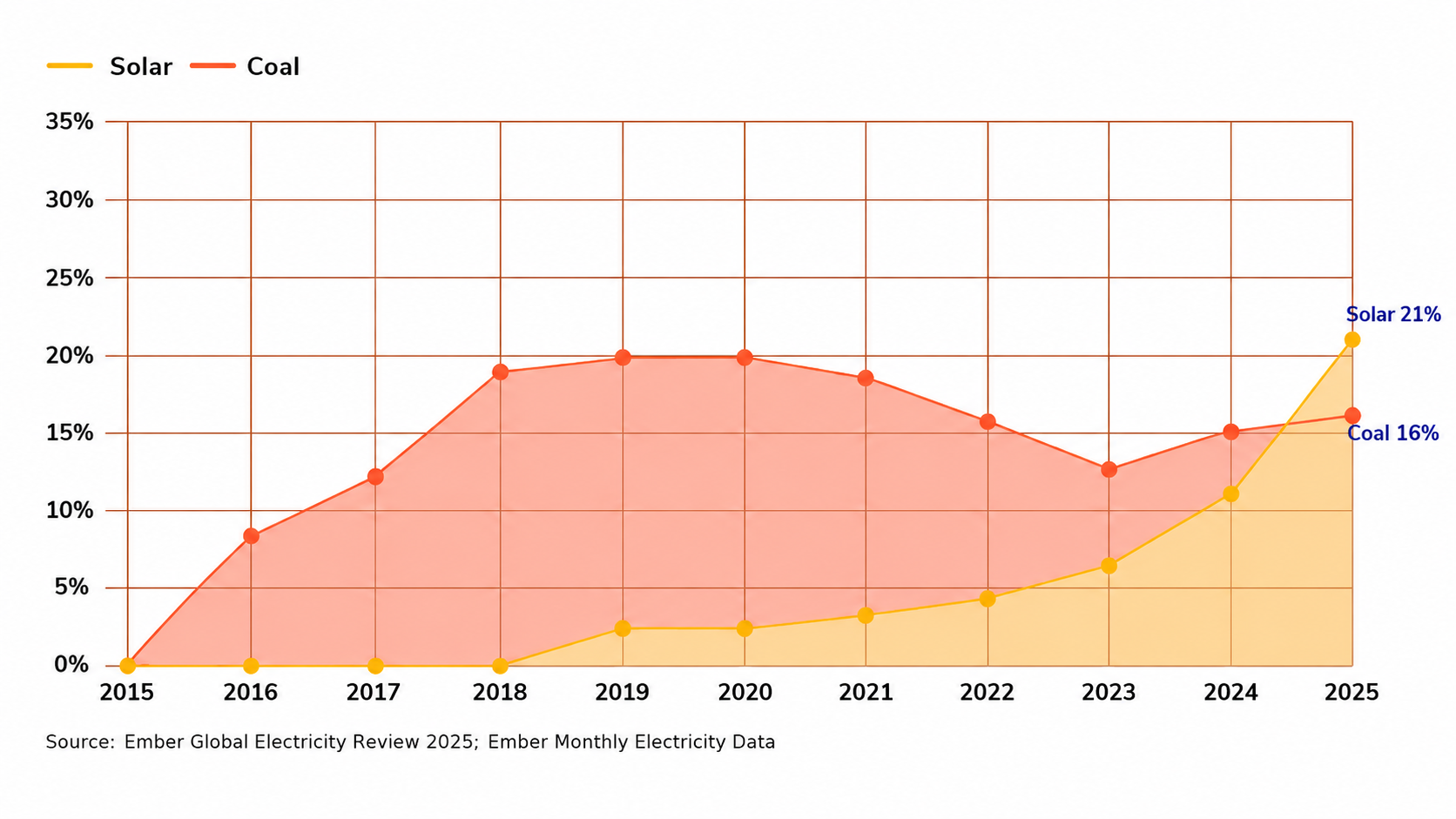
The same crisis that made Pakistan an energy cautionary tale is what drove one of the fastest solar adoptions anywhere in the world. But this is not a clean win. Fossil fuels still dominate the broader mix. Rapid, uncoordinated solar uptake creates real grid-level headaches – unstable voltages, reverse power flow, infrastructure never designed to handle distributed generation at this scale. And the benefits have not been evenly distributed; smaller businesses without access to upfront capital have largely been left behind by a transition that rewards those who can afford to move first. The story of Pakistan’s solar boom is less “problem solved” and more “what happens when necessity outruns planning.”
The Commercial Case Is Only Getting Stronger
Here is what that means for businesses still on the fence. Industrial electricity tariffs in Pakistan rose sharply over the past three years, fundamentally altering the commercial calculus around solar. The businesses that moved early on solar are now operating at a structural cost advantage over those that didn’t – lower electricity bills, insulation from tariff hikes, and uninterrupted operations during a summer when the grid, predictably, struggled to keep up.
The window for making this move cost-effectively is not permanently open. As demand for installations increases and import costs fluctuate, the economics will shift. The businesses getting the best returns today are the ones that committed before it became obvious to everyone.
The Way Forward Now?
Rapid solar adoption without structure is just a different kind of problem.
Wateen’s Energy Solutions exist precisely at that intersection. Commercial and industrial customers get end-to-end solar deployments – properly audited, correctly sized, and built with components including but not limited to solar panels, inverters, and battery energy storage systems from globally recognised manufacturers. These solar systems are designed to maintain uninterrupted operations, reducing both grid dependency and operating costs.
Wateen Energy Solutions provides state-of-the-art battery energy storage systems that, once in commission, are kept running through ongoing maintenance that protects performance over the long haul. Solar without storage is a fair-weather solution – useful when the sun is out, limited when it isn’t.
Pakistan has already proved that the transition to solar energy is a smart move. The economics are established, the technology is proven, and the case for reducing grid dependency has never been stronger for commercial and industrial operators.
The question now is not whether to make the move – it is how to make it count. A poorly planned solar solution is not just a missed opportunity; it is a long-term liability. The businesses that will get the most out of this shift are the ones that treat it as an infrastructure decision, not a procurement one – and partner accordingly.
If your business is ready to make solar work properly, click the link here.