

Artificial intelligence (AI) has become synonymous with automation. Both terms differ in meaning, but the comparison feels inevitable since many argue that automation is AI’s best use case. However, regardless of one’s opinion, companies have already begun adopting and heavily investing in AI.
From a company’s perspective, imagine completing maximum work in minimum time with minimal or no human involvement. This principle of achieving higher output with fewer inputs is precisely why AI is so successful right now and why tech giants are spending billions to claim the rights to say, “We were the first to achieve artificial general intelligence (AGI).”
We have some ways to go before it happens, but automation is here, and it’s more than simple chatbot prompting. A typical chatbot business query may look like this: “Analyze the attached six-month data on target audience interactions and provide actionable insights to improve weak service touchpoints.” You get your insights, performance improves, and everyone’s happy.
However, that part after the prompt is fiction, much like AI hallucinations. Expecting accurate results for complex problems in one go may rarely work. Your average large language models are not advanced enough to accurately solve a multitude of complex problems with a single prompt at this stage, much less automate them. To get the most value out of AI automation, you have to turn to AI agents, which are intelligent entities that are rapidly transforming industries and reshaping how we interact with technology.
From self-operating complex workflows to enhancing decision-making processes, AI agents are becoming indispensable tools in the modern technology ecosystem, and businesses of all sizes in Pakistan need to understand their significance to augment their overall productivity.
What is an AI Agent?
An AI agent is an autonomous software system that uses algorithms, machine learning (ML), and AI to make decisions without direct human input. Its main role is to perform and self-operate tasks ranging from simple reflexes to complex data-driven workflows. Ultimately, AI agents enhance productivity and streamline operations across various sectors.
Automating the Automation
Source: IBM
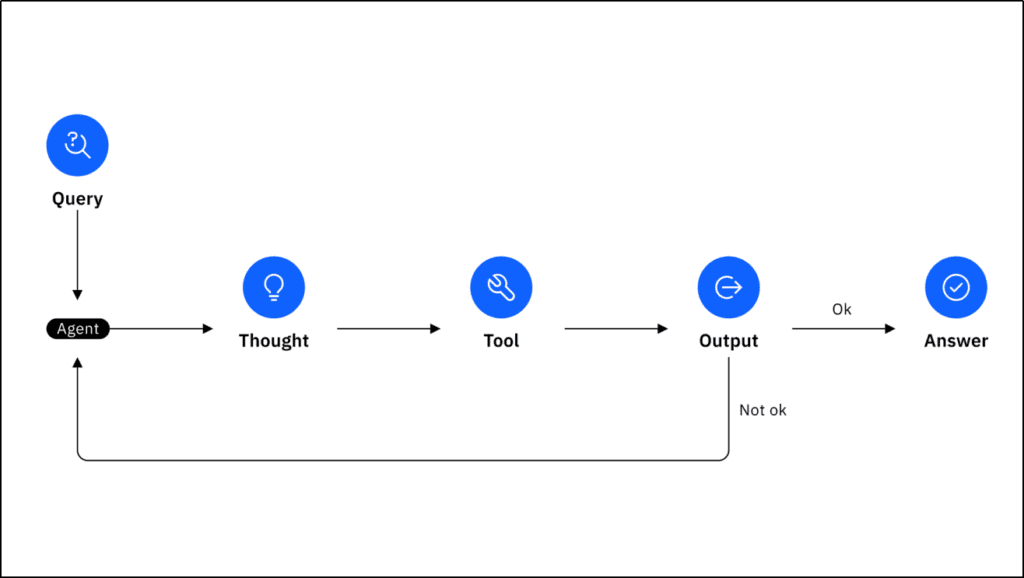
AI agents operate through a cycle of perception, reasoning, and action. Perception involves gathering data from the environment. Reasoning determines what to do with that data. Action executes the chosen decision.
For example, a customer service AI agent reads customer messages (perception), determines the best reply using built-in logic and feedback (reasoning), and sends a suitable response (action).
This mirrors how a human customer service representative works. They read messages, decide on the right response based on experience, and send it. Both learn from interactions and refine their performance over time. This ability to learn and adapt is what makes AI agents so effective.
Of course, customer service is only one example. Businesses can use other types of AI agents depending on their goals.
Types of AI Agents
There are several types of AI agents, each designed for specific environments and tasks:
- Simple reflex agents follow predefined rules, ideal for repetitive processes. Think of a traffic light that changes colors based on fixed timers or sensors detecting cars. It doesn’t think or plan, it just follows simple “if this, then that” rules. It is perfect for repetitive, predictable tasks and sums up simple reflex agents.
- Model-based reflex agents maintain internal representations to track factors beyond immediate data. Imagine a thermostat that not only senses the current temperature but also remembers past readings and knows how quickly your home warms up or cools down. It builds an internal “model” of how your home behaves to make better decisions.
- Goal-based agents work toward defined outcomes, and they are perfect when objectives and desired results are clear. Envision a navigation app that doesn’t just react to where you are but plans how to get you to your destination. It knows the goal (your endpoint) and makes decisions that move you closer to it. Navigation app workings are similar to how goal-based agents operate.
- Utility-based agents optimize results under varying conditions, and they are useful in tasks like scheduling or balancing multiple objectives. Think of a flight booking app that tries to find the best balance between cost, time, and comfort. It doesn’t just aim for one goal; it weighs several factors and picks the most satisfying option.
- Learning agents evolve through experience, ideal for dynamic problems where outcomes are unknown. The workings of a music recommendation app accurately illustrate how learning agents operate. It learns what you like over time. It notices which songs you skip or replay and improves future suggestions.
AI agents improve with feedback and training; ergo, with enough time and advancements, results for complex tasks will only get better. Your requirements should determine the kind of AI agent your business needs, be it a single-agent system or multi as there are other uses of AI agents besides automation.
Use Cases for AI Agents

In customer service, AI agents automate interactions, personalize support, and resolve issues efficiently. In finance, they can perform data analysis and assist in strategic decisions. Healthcare is another area where AI agents excel, as they can automate administrative tasks, support patient monitoring, and even aid in diagnosis. Each use case demonstrates how AI agents streamline complex workflows and raise productivity. AI agents on scale can change the landscape of Pakistan’s business sector in an instant, but as with anything in Pakistan, it is not that simple.
The Catch-Up Game for Pakistan
Pakistan’s AI-readiness is not proportionate to the number of broadband subscribers in the country. For 152 million subscribers in a population of 251.3 million, the country only ranks 9th across the 17 countries in South and Central Asia. This gap poses a challenge for the National AI Policy 2025. Closing it requires collaboration between policymakers and companies providing tailored AI solutions.
Businesses can benefit from custom AI agents developed by leading technology companies like Wateen, helping Pakistan catch up with global AI adoption.
Wateen’s Custom AI Agents For The Future
Wateen Telecom, Pakistan’s leading ICT company, delivers custom, enterprise-grade AI agent frameworks built for real operational use. Wateen’s approach focuses on end-to-end ownership, from infrastructure and data readiness to secure AI execution within governed environments.
Wateen designs Python-based AI agents that reason, decide, and act within defined business workflows. These agents run on on-premises or hybrid LLM environments, enhanced through RAG and enterprise knowledge sources, ensuring controlled, context-aware outcomes. Using workflow automation and orchestration tools such as n8n and RPA, AI agents integrate directly with core systems, APIs, and data platforms to automate business processes end-to-end.
The service is supported by Wateen’s infrastructure-first AI foundation, including GPU platforms, enterprise data lakes, and built-in security, governance, and audit controls, making it suitable for regulated sectors such as banking, telecom, and government.
Future Trends in AI Agents
The future points toward smarter, more independent AI systems. With ongoing progress in machine learning and generative AI, future agents will handle complex tasks and adapt seamlessly to changing environments.
Pakistan is heading in the right direction through its National AI Policy 2025. With stronger digital infrastructure and support from leading ICT companies like Wateen, the country could soon rank among the world’s top AI-ready nations.
Follow the link to explore ethical, custom AI agents designed to meet your business goals.